
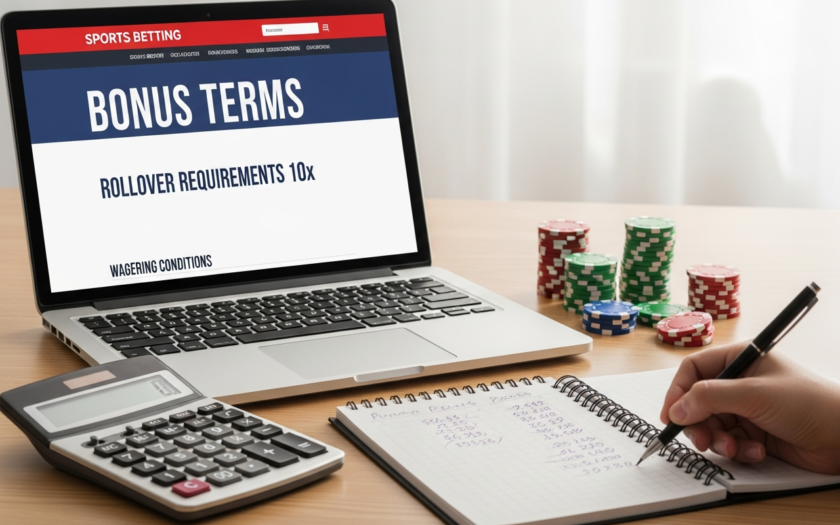
Indian sports betting sites frequently advertise generous bonuses—100% deposit matches, risk-free bets, and IPL-themed promotions—but the true value of these offers depends entirely on rollover requirements. Rollover (also called wagering requirement or playthrough) specifies how many times you must wager your deposit and/or bonus amount before you can withdraw any winnings. A seemingly attractive ₹10,000 bonus with 10× rollover means you’ll need to place ₹100,000 in qualifying bets before a single rupee can be withdrawn, turning what looked like free money into a long road of mandatory betting.
This guide provides everything Indian bettors need to understand and navigate rollover requirements. You’ll learn how rollover is calculated, which bonus terms carry the highest risk, practical strategies to meet wagering conditions safely, and when to walk away from a bonus altogether. Whether you’re a casual IPL punter or an experienced bettor managing a serious bankroll, this resource will help you evaluate bonus value, comply with terms and conditions, and avoid common pitfalls that can void your winnings.
What Is Rollover On Indian Sports Bonuses?
Rollover is the total wagering amount you must stake before bonus funds or associated winnings become withdrawable. When an Indian sportsbook credits a ₹5,000 bonus with 8× rollover, you must place ₹40,000 in qualifying bets—regardless of whether those bets win or lose—before you can cash out. Until you meet this threshold, bonus funds and any profits derived from them remain locked in your account.
Sportsbooks impose rollover requirements to prevent bonus abuse. Without these conditions, bettors could deposit, claim a bonus, and immediately withdraw both deposit and bonus without placing a single bet. Rollover ensures that players engage in meaningful betting activity, giving the bookmaker a chance to recoup promotional costs through the natural house edge. For Indian operators, rollover also filters out opportunistic users who hop between platforms to exploit welcome offers, preserving marketing budgets for genuine customers.
Understanding rollover is crucial because it transforms a bonus from a simple gift into a conditional contract. The multiplier, eligible markets, minimum odds, and time limits all combine to determine whether a bonus is achievable or a trap. A low-rollover bonus on your favourite IPL markets can offer real value; a high-rollover offer with restrictive terms may cost you more in losses than the bonus is worth.
Rollover vs Wagering vs Playthrough: Same Thing, Different Names
The terms rollover, wagering requirement, playthrough, and turnover requirement are used interchangeably across Indian sports betting sites. All describe the same concept: the total amount you must bet to unlock bonus funds. Some international platforms favour “playthrough,” while Indian operators often use “rollover” or “wagering requirement” in their promotions and terms.
Occasionally, sites distinguish between “turnover” (total bets placed) and “wagering requirement” (the multiplier applied to bonus or deposit). For practical purposes, Indian bettors should treat these as synonyms and focus on the multiplier and base amount. Whether a site says “5× turnover” or “5× playthrough,” the calculation remains identical: base amount multiplied by five equals total wagers required.
Why Indian Sportsbooks Use Rollover Requirements
Rollover requirements protect sportsbook profitability by ensuring bonuses deliver marketing value rather than instant losses. A ₹10,000 welcome bonus attracts new customers, but if every recipient could withdraw immediately, the operator would face millions in unrecovered promotional costs. Rollover conditions ensure that bonus recipients place enough bets for the house edge to naturally offset a portion of the bonus expense.
Rollover also encourages meaningful engagement. Operators want players to explore multiple markets, experience the platform, and ideally become long-term customers. A 6× or 8× rollover on a deposit match means you’ll spend days or weeks betting, during which time you may develop preferences for certain leagues, try live betting features, or join loyalty programmes. From the operator’s perspective, rollover is an investment in customer acquisition and retention.
For Indian bettors, this means rollover is non-negotiable. Complaining about wagering requirements is futile—they are baked into every bonus offer. The smarter approach is to evaluate whether a given rollover is achievable within your budget, time frame, and betting style, then decide whether to accept the bonus or decline it and bet with your own cash.
How Rollover Is Calculated On Indian Sports Bonuses
Rollover calculation depends on the base amount: some bonuses apply the multiplier only to the bonus itself, others to deposit plus bonus, and a few to the deposit alone. Each method drastically changes the total wagering required, so reading the terms carefully is essential before claiming any offer.
Bonus-only rollover is the most player-friendly. If you deposit ₹5,000 and receive a ₹5,000 bonus with 6× rollover on bonus only, you must wager ₹30,000 (₹5,000 × 6). Deposit+bonus rollover is stricter: the same offer with 6× on deposit+bonus requires ₹60,000 in wagers ((₹5,000 + ₹5,000) × 6). Deposit-only rollover is rare but occasionally appears in reload promotions, where you must turn over your deposit a set number of times regardless of bonus size.
| Bonus Type | Rollover Formula | Example In ₹ | Total Wager Needed |
|---|---|---|---|
| 100% Deposit Match (Bonus Only) | Bonus × Multiplier | ₹5,000 bonus × 6 | ₹30,000 |
| 100% Deposit Match (Deposit+Bonus) | (Deposit + Bonus) × Multiplier | (₹5,000 + ₹5,000) × 6 | ₹60,000 |
| 50% Reload (Bonus Only) | Bonus × Multiplier | ₹2,000 bonus × 5 | ₹10,000 |
| Free Bet (Stake Not Returned) | Free Bet Value × 1 | ₹1,000 free bet × 1 | ₹1,000 |
| Cashback (Bonus Only) | Cashback × Multiplier | ₹500 cashback × 3 | ₹1,500 |
Always confirm which base the multiplier applies to before depositing. Indian sportsbooks sometimes bury this detail deep in the terms, using phrases like “bonus amount and deposit must be wagered 8 times” to signal deposit+bonus rollover. If the terms are ambiguous, contact customer support and save a screenshot of their answer—this can protect you if a dispute arises later.
Step‑by‑Step Example: Turning A ₹10,000 Bonus Into Cash
Imagine you deposit ₹10,000 on an Indian sportsbook and claim a 100% welcome bonus with 8× rollover on deposit+bonus. Your account is credited ₹20,000 total: ₹10,000 real cash plus ₹10,000 bonus. The rollover base is ₹20,000, and the multiplier is 8, so your total wagering requirement is ₹160,000 (₹20,000 × 8).
You decide to bet on IPL matches at average odds of 1.90. Each ₹1,000 bet contributes ₹1,000 toward your rollover, regardless of the outcome. To meet ₹160,000 in turnover, you’ll need to place 160 bets of ₹1,000 each, or fewer larger bets totalling the same amount. Assuming a 5% house edge (typical for sports betting at those odds), you can expect to lose roughly ₹8,000 over the course of completing rollover. Since your bonus was ₹10,000, you net approximately ₹2,000 in real value—provided you meet all terms, avoid voiding conditions, and withdraw before any cap is applied.
This example shows why rollover multipliers matter. At 4× instead of 8×, your total wagering would be ₹80,000, halving expected losses to around ₹4,000 and increasing net value to ₹6,000. Conversely, a 12× rollover would demand ₹240,000 in bets and ₹12,000 in expected losses, turning the bonus into a net liability. Always calculate expected turnover and losses before committing to any bonus.
Key Rollover Terms You Must Check On Indian Sites
Beyond the multiplier, several critical terms determine whether a bonus is achievable or a minefield. Indian sportsbooks layer conditions on top of rollover, and overlooking even one can void your entire bonus balance and winnings. The most impactful terms include eligible markets, minimum odds, maximum bet limits, time constraints, and exclusions for certain bet types.
Reading the full terms and conditions—not just the promotional headline—is non-negotiable. Operators highlight the attractive multiplier (“only 6× rollover!”) but bury restrictive clauses in fine print. A 6× rollover with 1.80 minimum odds and a 14-day expiry is far harder than an 8× rollover with 1.50 minimum odds and 60 days to complete. Context is everything.
- Eligible markets: Some bonuses restrict rollover to specific sports (e.g., cricket only) or bet types (pre-match only, no live betting). Bets on excluded markets contribute zero toward rollover.
- Minimum odds requirement: Most Indian sportsbooks require odds of 1.50 to 1.80 or higher per selection. Bets below this threshold do not count, or count at reduced contribution rates (e.g., 50%).
- Maximum bet per wager: Caps like ₹5,000 or ₹10,000 per bet prevent you from clearing rollover with a few large wagers, forcing you to spread turnover across many smaller bets.
- Time limits: Bonuses typically expire 7 to 30 days after issuance. Any unmet rollover and associated winnings are forfeited at expiry.
- Excluded bet types: Arbitrage bets, cashed-out bets, voided selections, and certain system bets may be disqualified or trigger bonus cancellation.
- Maximum bonus winnings cap: Some promotions limit withdrawable winnings from bonus funds to 5× or 10× the bonus amount, regardless of how much you actually win.
- Country and payment restrictions: Certain bonuses exclude specific Indian states or payment methods (e.g., no bonus if depositing via cryptocurrency).
Minimum Odds And Eligible Markets For Rollover
Minimum odds requirements exist to prevent risk-free rollover through heavy-favourite betting. If a sportsbook allowed any odds to count, you could bet ₹100,000 on a 1.01 favourite, risk almost nothing, and clear rollover with minimal exposure. By mandating 1.50 or 1.80 minimum odds, operators force you to accept meaningful risk on each wager.
For Indian bettors, this typically means avoiding extreme favourites in IPL or international cricket. A bet on India to beat a weaker opponent at 1.20 odds would not contribute to rollover if the minimum is 1.50. Instead, you’d need to find markets like match winner at balanced odds, total runs over/under, or player performance bets that meet the threshold. Always check whether the minimum applies per selection (in accumulators, each leg must meet the threshold) or to the combined odds of a multi-bet.
Eligible markets vary widely. Some bonuses allow all sports; others restrict you to cricket, football, or tennis. Live betting may be excluded, or count at reduced rates (e.g., 50% contribution). If your preferred betting style focuses on niche markets like kabaddi or esports, confirm these qualify before claiming a bonus—otherwise, you’ll be locked into unfamiliar sports just to meet wagering conditions.
Time Limits, Caps And Other Hidden Restrictions
Time limits create urgency and increase the difficulty of meeting rollover. A 7-day deadline on a ₹10,000 bonus with 10× rollover means you must place ₹100,000 in qualifying bets within one week—an average of over ₹14,000 per day. For casual bettors who wager a few thousand rupees weekly, this is unachievable without reckless over-betting. Even experienced players may struggle to find enough qualifying markets at acceptable odds within such a short window.
Maximum bet caps prevent high-rollers from clearing rollover in a handful of large wagers. If the cap is ₹5,000 per bet and you need ₹80,000 in turnover, you must place at least 16 separate bets. This spreads your exposure and increases the likelihood of losses, benefiting the sportsbook. For Indian bettors managing smaller bankrolls, caps are less restrictive, but they still force diversification across multiple events.
Hidden restrictions include maximum withdrawal limits from bonus winnings (e.g., “maximum ₹50,000 can be withdrawn from this bonus”), which cap your upside even if you turn ₹5,000 into ₹100,000. Some terms also state that the bonus itself is non-withdrawable, meaning only net profit above the bonus amount can be cashed out. Always read the “Bonus Withdrawal Policy” section to understand exactly what portion of your balance becomes real money after rollover completion.
Common Types Of Sports Bonuses In India And Their Rollover
Indian sportsbooks offer several bonus structures, each with distinct rollover patterns, player advantages, and risks. Understanding how wagering requirements differ across bonus types helps you choose promotions that align with your betting habits and bankroll size.
Welcome bonuses typically feature the highest rollover multipliers—often 6× to 12×—because they target new customers with the largest promotional budgets. Ongoing promotions like reload bonuses, free bets, and cashback usually carry lower multipliers (3× to 5×) but come with tighter eligibility rules, such as minimum deposit thresholds or restrictions to specific events. Evaluating each bonus type’s rollover in context is essential for maximizing value.
| Bonus Type | Typical Offer In India | Usual Rollover Pattern | Pros For Player | Key Risk |
|---|---|---|---|---|
| 100% Deposit Match | Up to ₹10,000 or ₹20,000 | 6×–10× on deposit+bonus | Doubles initial bankroll | High total wagering; long completion time |
| Free Bet (SNR) | ₹500–₹2,000 free bet | 1× turnover; winnings often 3×–5× | Low rollover; easy to use | Stake not returned; capped winnings |
| Risk-Free Bet | Up to ₹5,000 refund if first bet loses | Refund as bonus credit; 5×–8× rollover | Protects first wager | Only triggers on loss; rollover on refund |
| Cashback | 5%–10% weekly losses back | 3×–5× on cashback amount | Recurring; softens losing streaks | Small amounts; still requires rollover |
| Reload Bonus | 25%–50% on subsequent deposits | 4×–6× on deposit+bonus | Smaller, more frequent boosts | Lower value; can stack unfavorable terms |
| IPL / Event-Specific | ₹1,000–₹5,000 bonus for IPL season | 5×–8× on bonus; IPL bets only | Tailored to popular Indian events | Narrow eligible markets; short event window |
Welcome Bonuses vs Ongoing Promotions: Rollover Differences
Welcome bonuses are designed to attract new sign-ups with large headline numbers—”100% up to ₹20,000!”—but the rollover multipliers and terms are typically the strictest you’ll encounter. Operators know first-time depositors are price-sensitive and will chase big bonuses, so they balance generous amounts with high wagering requirements (8×, 10×, or even 12× on deposit+bonus) and short expiry windows. Completing a welcome bonus often requires disciplined, daily betting over two to four weeks.
Ongoing promotions—reload bonuses, weekly cashback, acca insurance, and event-specific offers—usually feature lower rollover multipliers (3× to 5×) because they target existing customers whose lifetime value is already proven. However, these promos often come with tighter eligibility: minimum deposit amounts, restrictions to certain leagues or bet types, or caps on maximum bonus. For example, a 50% reload bonus up to ₹2,000 with 4× rollover sounds easy, but if it’s valid only on football accumulators with 1.80+ odds per leg, it may be harder to clear than a straightforward 6× welcome bonus on all cricket markets.
For Indian bettors, the best strategy is often to claim the welcome bonus if its terms are reasonable, then selectively use ongoing promotions that genuinely match your betting patterns. Chasing every reload or cashback offer can lead to over-betting and bonus fatigue, where you’re constantly locked into wagering requirements instead of placing value-driven bets.
How Rollover Affects The Real Value Of An Indian Sports Bonus
A bonus’s nominal amount is almost meaningless without considering rollover and expected losses. A ₹10,000 bonus with 12× rollover and 1.80 minimum odds demands ₹120,000 in turnover and exposes you to significant risk. Assuming a 5% house edge over that volume, you’d expect to lose ₹6,000, leaving only ₹4,000 in net value. Meanwhile, a ₹5,000 bonus with 4× rollover requires just ₹20,000 in turnover and roughly ₹1,000 in expected losses, netting ₹4,000 as well—making the smaller bonus equal or superior in real terms.
Expected value (EV) calculations help quantify this. Multiply your total rollover by the house edge percentage (typically 3%–6% depending on odds and sport) to estimate losses, then subtract from the bonus amount. If the result is positive and meaningful relative to the time and effort required, the bonus is worth claiming. If expected losses approach or exceed the bonus, you’re better off declining and betting your own cash without restrictions.
High rollover also increases variance. To meet ₹100,000+ in wagering, you’ll place dozens or hundreds of bets, and standard deviation means you could easily finish ₹10,000 below expectation—or ₹10,000 above. For casual bettors with limited bankrolls, this variance can lead to busting out before rollover is complete, forfeiting the bonus and any winnings. Lower rollover bonuses reduce this risk by requiring fewer total bets, giving you a smoother path to withdrawal.
Low vs High Rollover: Which Is Better For Indian Bettors?
- Low rollover (3×–5×): Easier to complete within deadline; lower expected losses; less variance; ideal for casual bettors or those new to sports betting.
- Low rollover cons: Typically smaller bonus amounts; may have stricter terms (e.g., single sport or event-specific).
- High rollover (8×–12×): Larger headline bonus; can be profitable for experienced bettors who bet high volume anyway; sometimes paired with better odds or fewer market restrictions.
- High rollover cons: Massive total wagering required; high expected losses; long completion time; high variance; risk of forfeiting if you cannot meet deadline or terms.
- Best choice for most Indian bettors: Moderate rollover (5×–7×) on bonus-only base, with flexible market eligibility and 1.50+ minimum odds, balancing achievable completion with meaningful bonus size.
When A Big Bonus Is Not Worth Taking
Despite the allure of a ₹20,000 welcome bonus, there are several scenarios where declining is the rational choice. If the rollover multiplier is 10× or higher on deposit+bonus, your total wagering requirement may exceed ₹200,000—far beyond your planned betting volume. Accepting forces you into over-betting, chasing turnover instead of value, and likely losing more than the bonus is worth.
If the eligible markets or minimum odds don’t align with your strategy, the bonus becomes a burden. A bettor who specializes in low-odds Asian handicaps won’t benefit from a bonus requiring 1.80+ odds on match-winner markets. Similarly, if you bet infrequently—perhaps only during IPL season—a 14-day expiry on a high-rollover bonus is impossible to meet without reckless daily wagers.
Finally, if you value withdrawal flexibility, bonuses lock your funds until rollover is complete. Betting with your own cash means you can withdraw anytime, adjust stakes freely, and never worry about voiding terms. For serious bettors focused on long-term profitability, the freedom and clarity of bonus-free betting often outweighs the marginal EV gain from promotions.
Strategies To Clear Rollover Safely On Indian Sportsbooks
Meeting rollover requirements without unnecessary losses demands discipline, planning, and a clear understanding of the terms. The strategies below help Indian bettors navigate wagering conditions efficiently while protecting their bankroll and maintaining compliance with bonus rules.
- Read the full terms and conditions before depositing: Confirm the rollover base (bonus-only or deposit+bonus), multiplier, minimum odds, eligible markets, time limit, and any exclusions. Screenshot key clauses for reference.
- Calculate total wagering required and expected losses: Multiply base × multiplier to find turnover, then estimate 3%–6% house edge losses. If losses approach the bonus value, reconsider claiming.
- Choose bets at moderate odds (1.70–2.20): These usually meet minimum odds requirements while offering better value than heavy favourites or long-shot accumulators. Avoid odds extremes that increase variance.
- Spread turnover across many small bets: Placing 50 bets of ₹2,000 is safer than 10 bets of ₹10,000. Smaller stakes reduce variance and give you more opportunities to find value.
- Track your rollover progress daily: Many Indian sites display turnover completion in your account dashboard. If not, maintain a spreadsheet logging each qualifying bet to ensure you’re on pace for the deadline.
- Avoid accumulator traps unless required: Multi-leg accumulators drastically increase variance. Unless the bonus mandates accas, stick to single bets or doubles to preserve capital.
- Never chase losses to meet rollover faster: If you hit a losing streak, stick to your plan. Increasing stakes or betting recklessly to recover losses or accelerate turnover usually deepens the hole.
Bankroll Management While Meeting Rollover
Sound bankroll management is even more critical when clearing rollover, because you’re forced to maintain betting volume regardless of results. A common guideline is to risk 1–3% of your total bankroll (deposit + bonus) per wager. For example, if you have ₹20,000 after claiming a bonus, each bet should be ₹200–₹600. This ensures you can sustain a losing streak without busting out before rollover is complete.
Avoid the temptation to bet your entire bonus balance on a single event, even at qualifying odds. One loss wipes out your bonus and leaves you scrambling to rebuild. Instead, divide your total wagering requirement by a realistic bet size to determine how many wagers you’ll place, then budget your bankroll to survive variance across that number of bets. If your plan requires 80 bets, ensure your unit size allows you to weather 10–15 consecutive losses without depleting funds.
Finally, separate your mindset: you’re not “playing with house money.” Once credited, bonus funds are part of your bankroll and should be managed with the same discipline as your deposit. Reckless betting because “it’s just bonus cash” is the fastest way to forfeit the promotion and lose your own money in the process.
Advanced Rollover Techniques For Experienced Indian Bettors
Experienced bettors can employ sophisticated strategies to clear rollover more efficiently, though all tactics must comply with the sportsbook’s terms and conditions. Violating bonus rules—even unintentionally—can result in forfeiture of bonus, winnings, and sometimes even your deposit. The techniques below reduce risk or accelerate completion, but always verify they’re permitted under your specific bonus terms.
| Technique | How It Helps With Rollover | Main Risk | Suitable For |
|---|---|---|---|
| Low-Margin Betting | Focus on markets with smallest house edge (e.g., Asian handicaps, draw-no-bet) | Still exposed to variance; requires market knowledge | Experienced bettors familiar with value betting |
| Odds Comparison | Compare odds across Indian and international sites to find best prices | Time-consuming; Indian sites may restrict certain regions | High-volume bettors seeking marginal EV gains |
| Dutching / Hedge Betting | Spread stakes across multiple outcomes to guarantee rollover contribution with minimal net loss | Explicitly prohibited by most bonus T&Cs; can void bonus | Use only if terms allow; otherwise high risk |
| Betting Exchange Lay | Back on sportsbook, lay same outcome on exchange to lock profit or minimize loss | Violates most bonus terms; Indian exchanges limited; high detection risk | Advanced arbitrageurs; not recommended for bonus play |
| Volume Focus on Fast Markets | Bet on high-frequency events (e.g., T20 innings totals, tennis games) to complete turnover quickly | Rushed decisions; less time for research; higher emotional betting risk | Disciplined bettors comfortable with in-play markets |
Low-margin betting—focusing on markets like Asian handicaps or draw-no-bet where the bookmaker’s edge is smallest—can reduce expected losses during rollover. Pair this with odds comparison tools to ensure you’re always getting the best available price. However, even low-margin bets carry variance, so bankroll discipline remains essential.
Using Odds Comparison And Exchanges To Reduce Risk
- Use odds aggregators: Websites and apps that compare odds across multiple Indian sportsbooks help you identify the best line for each bet, shaving percentage points off the house edge over dozens of wagers.
- Monitor line movement: Odds shift as markets develop. Placing bets when lines first open or just before events start can sometimes capture better value, though this requires active monitoring.
- Leverage betting exchanges where legal: Exchanges allow you to request your own odds or match other bettors’ offers, often yielding better prices than fixed-odds sportsbooks. However, exchange availability is limited in India, and using them to hedge bonus bets typically violates terms.
- Track closing line value (CLV): If you consistently beat the closing odds, you’re likely finding value. Over time, positive CLV betting reduces rollover losses and can even turn a profit independent of the bonus.
Behaviours That Can Void Your Bonus During Rollover
Sportsbooks actively monitor bonus accounts for patterns that suggest abuse or advantage play. Arbitrage betting—placing opposing bets on the same event to guarantee profit—is explicitly banned in nearly all bonus terms. If detected, your bonus, winnings, and sometimes deposit will be confiscated. Similarly, cash-out abuse (repeatedly cashing out to reduce risk while still contributing to rollover) is flagged by fraud systems and can trigger account suspension.
Other voiding behaviours include betting on both sides of the same market across multiple accounts, colluding with other players to guarantee outcomes, or using automated bots to place bets. Even innocent mistakes—like exceeding the maximum bet limit or placing a wager on an excluded market—can disqualify that bet from rollover or void the entire bonus. Always double-check terms before each bet, and avoid any strategy that feels like it’s circumventing the spirit of the promotion.
Indian‑Specific Considerations Around Rollover And Withdrawals
Indian bettors face unique challenges related to payment methods, regulatory compliance, and withdrawal friction that interact with rollover requirements in ways not seen in more regulated markets. Understanding these factors ensures you can actually access your winnings once rollover is complete, avoiding frustrating delays or account freezes.
Most international sportsbooks serving Indian customers operate offshore and process payments through third-party processors, e-wallets, or cryptocurrency. Withdrawal times can range from a few hours to several days, depending on the method. Crucially, many sites impose mandatory KYC (Know Your Customer) verification before allowing the first withdrawal, and this process can take 24–72 hours or longer if documents are incomplete. If you clear rollover but haven’t completed KYC, your funds remain locked until verification finishes.
Payment method restrictions also matter. Some bonuses are ineligible if you deposit via certain methods (e.g., Skrill, Neteller, or cryptocurrency), and you’re often required to withdraw using the same method you deposited. If your deposit method doesn’t support withdrawals (e.g., some prepaid cards or UPI in certain cases), you must add and verify an alternative method before cashing out, adding further delay.
Rollover, KYC And Withdrawal Friction For Indian Players
- Complete KYC verification immediately after registration: Upload government ID (Aadhaar, PAN, passport), proof of address, and any requested payment confirmations before you even claim a bonus. This avoids withdrawal delays later.
- Use deposit methods that support fast withdrawals: E-wallets like Paytm, PhonePe, or crypto often process faster than bank transfers. Confirm your chosen method is eligible for both deposits and withdrawals under the bonus terms.
- Expect withdrawal friction on first cash-out: Indian players commonly face additional verification requests—selfie with ID, bank statements, source-of-funds declarations—during the first withdrawal. Budget extra time and keep documents ready.
- Understand currency conversion fees: If the sportsbook operates in USD or EUR and you deposit in INR, conversion fees apply on both deposit and withdrawal, potentially eating 2%–4% of your bonus value. Look for rupee-native platforms when possible.
- Monitor regulatory changes: Indian states periodically update gambling laws and payment regulations. Stay informed to avoid depositing on platforms that may face sudden payment-processor bans, trapping your funds.
Checklist Before Claiming Any Indian Sports Bonus
Use this step-by-step checklist to evaluate every sports bonus offer before committing your deposit. Skipping even one step can lead to unfavorable terms, unmet rollover, or forfeited winnings.
- Verify the rollover multiplier and base amount: Confirm whether rollover applies to bonus only, deposit only, or deposit+bonus. Calculate total wagering required.
- Check minimum odds and eligible markets: Ensure your preferred sports and bet types qualify, and that minimum odds (typically 1.50–1.80) match your strategy.
- Review the time limit: Confirm you can realistically complete the required turnover within the expiry period given your betting frequency and bankroll.
- Read all exclusions and restrictions: Look for caps on maximum bonus winnings, excluded bet types (e.g., cashed-out bets, system bets), and any regional or payment-method restrictions.
- Estimate expected value: Multiply total rollover by 3%–6% house edge to estimate losses, then subtract from bonus amount. Proceed only if net EV is positive and meaningful.
- Confirm KYC and withdrawal requirements: Ensure your account is verified and your deposit method supports withdrawals. Understand any currency-conversion or processing fees.
- Assess your risk tolerance and bankroll: Determine whether the variance and time commitment fit your betting style. If in doubt, skip the bonus and bet cash.
- Screenshot or save the full terms: Bonus T&Cs can change or disappear. Keep a local copy for reference in case of disputes.
Red Flags That Signal A Poor‑Value Bonus
| Red Flag | Why It Is Dangerous | Better Alternative |
|---|---|---|
| Rollover 12× or higher on deposit+bonus | Massive wagering volume; expected losses often exceed bonus value | Seek 6×–8× bonus-only rollover with same headline amount |
| Expiry within 7 days | Forces rushed, high-variance betting; difficult for casual players | Choose bonuses with 21–30 day validity |
| Minimum odds 2.00+ per selection | Eliminates safer bets; pushes you toward high-risk markets | Look for 1.50 or 1.60 minimums allowing broader market access |
| Max bonus winnings capped at 2× or 3× bonus | Limits upside; your best results are forfeited above the cap | Prefer uncapped bonuses or caps at 10× or higher |
| Vague or missing terms on eligible markets | Operator can retroactively disqualify bets, voiding rollover progress | Only claim bonuses with clear, detailed T&Cs; contact support for clarification |
| No KYC or licensing information on site | High risk of non-payment or account closure; no regulatory recourse | Use only licensed operators (Curacao, Malta, etc.) with transparent KYC policies |
When To Skip A Bonus And Just Bet Cash
Declining a bonus is often the smartest decision. If you bet infrequently—say, only during major cricket tournaments—a high-rollover bonus with a 30-day expiry forces you into artificial betting volume that doesn’t match your natural habits. You’ll either fail to meet rollover, forfeiting the bonus, or over-bet and lose more than the bonus was worth.
Similarly, if you prefer flexibility—adjusting stakes based on confidence, cashing out early, or withdrawing winnings mid-session—bonus restrictions eliminate these advantages. Betting with your own funds means you can withdraw anytime, pivot strategies without worrying about disqualifying terms, and never risk having winnings voided due to a technicality. For serious bettors focused on long-term profitability rather than chasing promotions, the freedom of cash betting often delivers better results than the marginal EV of bonuses.