Esports betting has surged in popularity across India as competitive gaming moves into the mainstream. From CS2 and Dota 2 to Valorant and League of Legends, Indian bettors now have access to a growing range of markets on offshore platforms that accept INR, support UPI payments, and offer desktop and mobile apps. This guide walks through the practical steps to place esports bets from India, covering market types, odds reading, payment methods, and site selection without promoting specific brands.
Before depositing funds, it is essential to understand the legal grey area surrounding online betting, the differences between local and offshore operators, and the importance of KYC verification and secure payment channels. Rather than offering ranked lists of bookmakers, this article focuses on the mechanics of market evaluation, risk management, and the unique factors that define esports betting—such as patch notes, map pools, and tournament formats—so you can make informed decisions regardless of which platform you eventually choose.
Is Esports Betting in India Legal and Accessible?
Online esports betting occupies a grey zone in Indian law. The Public Gambling Act of 1867 predates the internet, and individual states retain the power to regulate gambling within their borders. There is no federal statute that explicitly legalizes or prohibits betting on esports through offshore platforms, which means enforcement is inconsistent and largely focused on operators rather than individual bettors. Most Indians access international sportsbooks licensed in jurisdictions such as Curaçao, Malta, or the United Kingdom, where esports markets are offered alongside traditional sports.
Access to these platforms is straightforward. Offshore operators provide dedicated desktop sites, responsive mobile browsers, and Android or iOS apps, often with full INR currency support. Many accept UPI, IMPS, Paytm, credit and debit cards, and increasingly cryptocurrencies for deposits and withdrawals. Every account requires KYC verification—uploading a government ID and proof of address—before the first withdrawal is approved, a standard anti-money-laundering measure that also protects your funds.
The lack of a clear regulatory framework means players must take responsibility for verifying the legitimacy of a platform before registering. While offshore sites are generally accessible, the legal ambiguity persists, and it is wise to monitor local news and legal updates in your state.
What Indian Players Need to Know About Regulation
Local versus foreign-licensed platforms present different risk and compliance profiles. Indian fantasy sports operators argue that their contests fall under skill-based gaming and thus remain legal in most states, but traditional fixed-odds betting—including esports markets—does not enjoy the same statutory protection. Offshore sportsbooks licensed by recognized gaming authorities operate under their home jurisdiction’s laws and are not subject to Indian oversight, which places the onus on you to confirm their credentials.
Before committing funds, verify the operator holds a valid license from a reputable regulator and check whether your state has issued any explicit prohibition. Some states have enacted legislation that restricts online gambling more broadly, so due diligence is essential.
Safe Access Basics: Accounts, KYC, and Payments
Registration typically requires an email address, mobile number, and password. Upon signup, you will be asked to verify your email and phone number through one-time codes. KYC verification follows: upload a clear scan of your Aadhaar card, PAN card, or passport, plus a recent utility bill or bank statement showing your address. Most platforms approve KYC within 24 to 48 hours, and until verification is complete, withdrawals are blocked.
Funding an account is quick. UPI and IMPS transactions settle instantly, while card deposits may take a few minutes. Cryptocurrency deposits require confirmations on the blockchain and can take up to an hour. Withdrawals reverse the process: UPI and IMPS payouts typically arrive within hours, cards within one to three business days, and crypto within a few hours once processed. Always check the minimum and maximum deposit limits, any conversion fees from USD or EUR to INR, and withdrawal thresholds before funding your account.
Which Esports Markets Are Most Common?
Esports betting markets have evolved far beyond simple match winner wagers. Modern sportsbooks offer dozens of options across CS2, Dota 2, League of Legends, and Valorant, ranging from map totals and round handicaps to granular proposition bets on first blood, tower kills, or pistol-round outcomes. Understanding the structure of each market helps you identify value and manage risk more effectively.
Pre-match betting allows you to place wagers hours or days before a tournament match begins, locking in odds that reflect early public sentiment and team form. Live esports betting opens during the match itself, with odds updating in real time as rounds, maps, or objectives are completed. Live markets demand quick decision-making and a solid grasp of momentum shifts, patch effects, and team drafting strategies.
The table below summarizes the most common market types, how each works, which situations favor them, and the typical risk profile.
| Market type | How it works | Best for | Risk level |
|---|---|---|---|
| Match Winner | Pick which team wins the series or best-of-X | Beginners, straightforward analysis | Low to moderate |
| Map Handicap | Back a favorite to win by more maps or underdog to stay within spread | Matches with strong favorites | Moderate |
| Over/Under Maps | Bet on total maps played in series exceeding or falling below a line | Even matchups, BO3 or BO5 formats | Moderate |
| Round Handicap (CS2, Valorant) | Adjust final round margin for favorite or underdog | Close teams with small skill gaps | Moderate to high |
| First Blood / First Tower (Dota 2, LoL) | Predict which team scores the first kill or objective | Early-game aggression specialists | High (volatile) |
| Tournament Winner / Outright | Select the champion before tournament starts | Long-term value seekers | High (variance over multiple matches) |
| Over/Under Kills (Dota 2, LoL) | Bet on total kills in a match or map exceeding a threshold | Aggressive meta periods | Moderate to high |
Each game title brings its own suite of specialist markets. CS2 and Valorant offer pistol-round winners, bomb-plant props, and knife-round outcomes. Dota 2 and League of Legends feature Roshan or Baron timing bets, inhibitor destruction, and creep-score leaders. Valorant markets include agent-pick props and spike-plant counts. The depth of available markets varies by tournament tier: major events such as The International or Valorant Champions offer dozens of props per match, while lower-tier leagues may list only match winner and map totals.
Core Market Types You Will See on Bookmakers
Pre-match and live betting differ primarily in timing and information flow. Pre-match odds are set based on historical data, recent form, roster changes, and public perception. Live odds react to in-game events: a won pistol round in CS2 or an early Roshan kill in Dota 2 can shift odds by 20 percent or more within seconds. Proposition bets—often called props—focus on specific in-game events rather than final outcomes, adding another layer of complexity and opportunity.
| Market | Definition | Example |
|---|---|---|
| Match Winner (Pre-match) | Fixed odds on series outcome before first map starts | Team A 1.65, Team B 2.20 in BO3 |
| Match Winner (Live) | Odds update in real time as rounds or maps are completed | Team A 1.40 after winning map 1 |
| First Blood | Which team scores the opening kill of a map or match | Team A 1.85, Team B 1.95 |
| Round Handicap | Adjust final round score by a set margin | Team A –3.5 rounds at 1.90 |
| Pistol Round Winner | Predict winner of the opening pistol round (CS2, Valorant) | Team A 1.75, Team B 2.05 |
| Total Kills Over/Under | Combined kills in a Dota 2 or LoL match exceed or fall below a line | Over 52.5 kills at 1.85 |
| Map Totals (Over/Under) | Total number of maps played in a series | Over 2.5 maps in BO3 at 2.10 |
Understanding these distinctions allows you to choose markets that match your research strengths and risk tolerance. Live betting rewards fast reflexes and deep game knowledge, while pre-match markets favor systematic research and patience.
How to Read Esports Odds and Market Lines
Esports odds come in three primary formats: decimal, fractional, and American. Indian bettors will most often encounter decimal odds, which are the simplest to calculate. A decimal odd of 2.00 means a successful ₹1,000 wager returns ₹2,000 total—your original stake plus ₹1,000 profit. Odds below 2.00 indicate the favorite, while odds above 2.00 suggest the underdog.
Reading market lines involves more than recognizing favorites and underdogs. You must assess implied probability, compare odds across multiple bookmakers, and factor in the margin or “vig” the operator builds into each market. An implied probability is calculated by dividing 1 by the decimal odd: an odd of 1.75 implies a 57.1 percent chance of that outcome. When the sum of implied probabilities for all outcomes exceeds 100 percent, the excess represents the bookmaker’s edge.
Effective odds reading also requires contextual knowledge. Recent roster changes, patch updates that shift the meta, or a team’s historical performance on specific maps can all influence whether published odds offer genuine value. The steps below outline a systematic approach to evaluating any esports line before committing funds.
Odds Formats and What They Mean
Decimal odds dominate in India and across most of Europe and Asia. American odds, common in the United States, use positive and negative integers to represent underdogs and favorites. Fractional odds remain popular in the United Kingdom but are less intuitive for quick calculations. The table below compares the three formats with practical examples.
| Format | Typical use | Example |
|---|---|---|
| Decimal | India, Europe, Asia, most offshore sites | 2.00 returns ₹2,000 on ₹1,000 stake |
| American | United States | +150 (underdog) or –200 (favorite) |
| Fractional | United Kingdom, Ireland | 5/2 means ₹500 profit on ₹200 stake |
Most platforms allow you to switch the display format in account settings. If you are comfortable with decimal odds, keep that setting to simplify payout calculations and implied-probability checks.
A Simple Pre-Bet Reading Process
Before placing any wager, follow a structured checklist to ensure you have accounted for all material factors. The steps below help reduce impulsive decisions and improve long-term profitability.
- Check recent match results and head-to-head records. Look for patterns on specific maps or game modes. A team with a 70 percent win rate on Dust2 in CS2 may be undervalued if the bookmaker’s odds imply only 60 percent.
- Review roster and stand-in announcements. Last-minute substitutions or illness can dramatically shift balance, especially in team-based MOBAs like Dota 2 where communication and synergy are critical.
- Read patch notes and meta shifts. Major updates to weapon balance, hero nerfs, or item changes can invalidate historical data. A Valorant agent nerf may weaken a team that specialized in that character.
- Assess tournament context and motivation. Group-stage dead rubbers may see resting of star players, while playoff matches demand peak performance. Motivation discrepancies create line value.
- Compare odds across multiple sportsbooks. Even a 0.05 difference in decimal odds compounds over many bets. Maintain accounts at two or three platforms to shop for the best price.
This process takes five to ten minutes per match and significantly improves decision quality compared to betting on brand recognition or gut feeling alone.
How to Place an Esports Bet Step by Step
Placing your first esports wager involves a sequence of account setup, funding, market selection, and confirmation steps. While interfaces vary by operator, the core flow remains consistent. Understanding each stage reduces errors and ensures you can track your bets and manage your bankroll effectively.
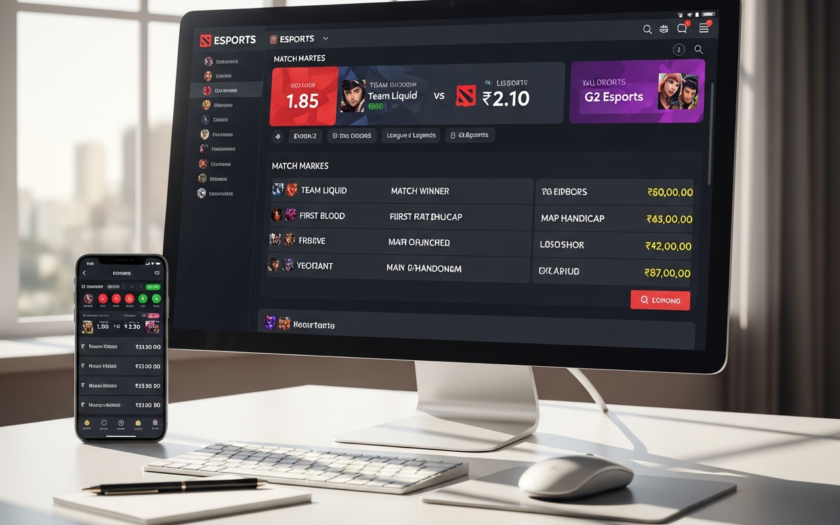
Modern platforms offer both pre-match and live betting interfaces. Pre-match markets are accessible hours or days in advance, with static odds that update periodically. Live betting dashboards refresh every few seconds, displaying real-time scores, round counts, and dynamic odds. Many operators also provide match trackers, live streams, or embedded scoreboards to help you follow the action without switching tabs.
The steps below cover the complete journey from registration through to bet settlement, including tips for live esports betting where speed and situational awareness are paramount.
From Registration to Settlement
Follow this sequence to place your first esports bet securely and efficiently.
- Create an account. Visit the operator’s homepage, click the registration button, and enter your email, mobile number, date of birth, and a strong password. Confirm your email and phone number via one-time codes sent by the platform.
- Complete KYC verification. Upload a government-issued ID (Aadhaar, PAN, passport) and proof of address (utility bill, bank statement dated within three months). Approval typically takes 24 to 48 hours; some platforms allow deposits before KYC but block withdrawals until verification is complete.
- Make your first deposit. Navigate to the cashier or deposit section, select a payment method—UPI, IMPS, card, or crypto—and enter the amount. Confirm the transaction and wait for the balance to appear in your account, usually within seconds for UPI or minutes for cards.
- Browse esports markets. Use the sportsbook menu to filter by esports or specific titles such as CS2, Dota 2, or Valorant. Select an upcoming match and review available markets: match winner, map totals, handicaps, and props.
- Add selections to your bet slip. Click the odds for your chosen outcome. The bet slip—usually a sidebar or pop-up—displays your selection, current odds, and a stake input field. Enter your wager amount and review the potential return.
- Confirm and place the bet. Double-check the odds, stake, and market type. Click the confirm or place bet button. A confirmation message appears with a unique bet ID. Save or screenshot this for your records.
- Monitor and settle. Track your bet in the “My Bets” or “Open Bets” section. For live bets, the interface updates in real time as rounds or maps conclude. Once the match ends, winning bets are credited to your account balance within minutes; losing bets are deducted immediately upon placement.
Live esports betting adds urgency to this process. Odds fluctuate rapidly, and you may have only seconds to lock in a favorable line after a key event such as a won pistol round or an early objective. Ensure you have a stable internet connection and familiarize yourself with the platform’s live-betting layout before a high-stakes match begins.
Which Indian Payment Methods Work Best?
Indian bettors benefit from a diverse range of deposit and withdrawal options tailored to the local market. UPI has emerged as the fastest and most convenient method, offering instant transfers directly from your bank account with minimal fees. IMPS and NEFT provide similar bank-to-bank functionality, while credit and debit cards remain popular despite occasional issuer blocks on gambling transactions. Paytm and other e-wallets are accepted by some operators, though coverage is less universal than UPI. Cryptocurrency deposits—Bitcoin, Ethereum, USDT—are increasingly common, appealing to users who value privacy and want to avoid currency conversion fees.
Each method carries distinct speed, limit, and fee characteristics. UPI deposits settle within seconds and typically carry no fee, but daily transaction limits imposed by your bank may cap large deposits. Cards offer higher limits but may incur foreign-transaction fees if the operator processes payments in USD or EUR. Cryptocurrency deposits bypass traditional banking altogether, though blockchain confirmation times and exchange-rate volatility introduce their own complexities.
Withdrawal speed often lags deposit speed. UPI and IMPS payouts usually arrive within a few hours, but the operator’s internal processing time—ranging from instant to 24 hours—adds delay. Card withdrawals can take one to three business days, and some platforms require you to withdraw via the same method used for deposit, a rule designed to prevent money laundering.
| Method | Speed | Typical limits | Notes |
|---|---|---|---|
| UPI | Instant (deposit), 1–6 hours (withdrawal) | ₹500 – ₹100,000 per transaction | No fees, subject to bank daily caps |
| IMPS | Instant (deposit), 1–6 hours (withdrawal) | ₹1,000 – ₹200,000 per transaction | Available 24/7, minimal downtime |
| Credit/Debit Card | 1–5 minutes (deposit), 1–3 days (withdrawal) | ₹500 – ₹500,000 per transaction | May incur foreign-transaction fees |
| Paytm / E-wallets | Instant (deposit), 1–12 hours (withdrawal) | ₹500 – ₹50,000 per transaction | Limited operator support |
| Cryptocurrency | 10–60 minutes (deposit), 1–6 hours (withdrawal) | No fixed limits, network-dependent | Avoids INR conversion, subject to volatility |
Before selecting a payment method, confirm the operator accepts your preferred option for both deposits and withdrawals, and verify any minimum or maximum thresholds that might restrict your bankroll management strategy.
Deposit and Withdrawal Options
Deposit and withdrawal timelines vary by method and operator processing policy. The table below breaks down typical speeds and common caveats for each option.
| Method | Deposit speed | Withdrawal speed | Common caveat |
|---|---|---|---|
| UPI | Instant | 1–6 hours | Bank daily caps apply |
| IMPS | Instant | 1–6 hours | 24/7 availability, stable |
| Credit/Debit Card | 1–5 minutes | 1–3 business days | May be blocked by issuer |
| Paytm | Instant | 1–12 hours | Limited operator support |
| Bitcoin (BTC) | 10–60 minutes | 1–6 hours | Exchange-rate volatility |
| Ethereum (ETH) | 5–30 minutes | 1–6 hours | Gas fees vary by network congestion |
| USDT (Tether) | 5–30 minutes | 1–6 hours | Stable value, minimal conversion risk |
Minimum deposit amounts typically range from ₹500 to ₹1,000. Some operators waive fees on UPI and IMPS transactions but charge 1–3 percent on card deposits due to processing costs. Cryptocurrency deposits avoid currency conversion but require you to manage exchange-rate risk and blockchain network fees.
What to Check Before Funding an Account
Before transferring funds, review the following points to avoid unexpected costs or restrictions that could lock your capital or reduce your effective bankroll.
- Currency conversion fees and exchange rates. If the operator’s base currency is USD or EUR, check the INR conversion rate and any hidden markup. A poor exchange rate can erode 2–3 percent of your deposit value.
- Bonus terms and wagering requirements. Deposit bonuses often come with rollover conditions—such as betting the bonus amount five or ten times—before you can withdraw. Declining a bonus may be wiser if the terms are restrictive.
- Withdrawal limits and processing times. Confirm daily, weekly, and monthly withdrawal caps. Some platforms impose a ₹50,000 daily limit, which can delay large payouts over several days.
- KYC status and document validity. Ensure your uploaded documents are current and clearly legible. Expired IDs or blurry scans will delay verification and block withdrawals.
- Payment-method fees. While UPI and IMPS are usually free, card transactions may incur a 1–3 percent processing fee. Cryptocurrency deposits avoid bank fees but expose you to blockchain network fees and exchange-rate fluctuations.
Taking ten minutes to review these details can prevent frustration and protect your bankroll from avoidable deductions or delays.
How to Reduce Risk and Bet Smarter
Esports betting carries inherent variance due to patch updates, roster instability, and the rapid evolution of competitive metas. Reducing risk requires a disciplined approach to bankroll management, market specialization, and odds shopping. Setting hard limits on stake size—such as risking no more than 2 percent of your total bankroll per bet—prevents a losing streak from depleting your funds. Specializing in one or two game titles allows you to build deep knowledge of team dynamics, map pools, and patch effects, giving you an edge over casual bettors who spread attention too thin.
Odds shopping is the practice of comparing lines across multiple sportsbooks before placing a wager. A difference of 0.05 in decimal odds may seem trivial, but over hundreds of bets it compounds into significant profit or loss. Maintain accounts at two or three reputable operators and check each before confirming a bet. Avoid chasing losses by increasing stake size after a bad run; variance is normal, and discipline separates long-term winners from those who blow their bankroll in a single session.
Live betting introduces additional risk. Odds move quickly, and emotional reactions to in-game events can lead to impulsive wagers. Set a separate live-betting budget and stick to pre-planned strategies, such as backing a team only after they lose the first map in a best-of-three at inflated odds.
The checklist below outlines practical steps to bet smarter and protect your capital over the long term.
- Set a fixed percentage stake per bet. Risk 1–2 percent of your bankroll on any single wager. This shields you from catastrophic losses and allows you to survive normal variance.
- Specialize in one or two esports titles. Deep knowledge of CS2 or Dota 2 beats superficial familiarity with five different games. Track roster changes, map statistics, and recent patches religiously.
- Compare odds across multiple bookmakers. Even a 0.05 edge per bet compounds over time. Use odds-comparison tools or manually check three platforms before placing each wager.
- Avoid parlays and accumulators unless the edge is clear. Combining multiple selections multiplies risk and reduces the probability of winning. Single bets offer better control and transparency.
- Keep detailed records of every bet. Log date, match, market, stake, odds, and outcome in a spreadsheet. Analyze your performance monthly to identify strengths, weaknesses, and patterns.
- Never chase losses by increasing stake size. Losing streaks are part of betting. Stick to your unit size and trust the process. Emotional escalation leads to ruin.
Discipline and systematic analysis separate profitable bettors from those who treat esports wagering as entertainment rather than a skill-based endeavor.
Esports-Specific Betting Angles
Esports present unique analytical opportunities that traditional sports lack. Patch notes, team drafts, and tournament formats all influence outcomes in ways that reward specialized research.
- Monitor patch notes and meta shifts. Major updates to game balance can invalidate months of historical data. A hero nerf in Dota 2 or weapon adjustment in Valorant may weaken a team that specialized in that strategy, creating line value for informed bettors.
- Analyze team drafts and map vetoes. In CS2 and Valorant, map veto phase reveals strategic priorities. A team banning its weakest maps may signal confidence or desperation. Track veto patterns to predict map outcomes before odds adjust.
- Evaluate tournament stage and motivation. Group-stage dead rubbers often see experimental drafts or rested star players. Playoff matches demand peak performance. Mismatched motivation creates exploitable lines.
- Study individual player form and role changes. A star AWPer in CS2 or mid-laner in League of Legends going through a slump can tilt team balance. Conversely, a breakout performance from a substitute can be undervalued by bookmakers relying on season averages.
- Track offline versus online performance. LAN tournaments introduce travel fatigue, crowd pressure, and hardware differences. Some teams excel online but falter at majors, while others thrive under LAN intensity. Historical LAN performance is a better predictor for playoff matches than online league stats.
These angles require active engagement with the esports community—watching matches, reading analyst breakdowns, and following social media for roster news—but they offer edges that bookmakers cannot instantly price into their lines.
How to Choose a Trustworthy Esports Betting Site
Selecting a reliable platform is the foundation of a safe and profitable betting experience. Licensing, payout speed, app quality, and customer support all matter. A valid license from Curaçao, Malta, or the UK Gambling Commission signals that the operator is subject to regulatory oversight, financial audits, and player-protection standards. Unlicensed sites may offer attractive bonuses, but they carry the risk of delayed payouts, rigged odds, or outright scams.
Payout speed reflects operational efficiency and financial health. Operators that process withdrawals within hours demonstrate strong cash flow and respect for customer funds. Those that delay payouts for days or impose unexplained holds may be struggling financially or using withdrawal friction to discourage cashouts. App quality matters for live betting: a laggy mobile interface can cause you to miss favorable odds or place unintended wagers.
Customer support should be accessible via live chat, email, and ideally phone, with response times under an hour during business hours. Test support before depositing by asking a simple question about KYC or payment methods; slow or unhelpful responses are a red flag.
| Criterion | Why it matters | Good sign |
|---|---|---|
| Valid License | Ensures regulatory oversight, fair odds, and dispute resolution | License number displayed in footer, verifiable on regulator site |
| Fast Payouts | Indicates strong cash flow and respect for customer funds | Withdrawals processed within 1–6 hours for UPI/IMPS |
| App Quality | Critical for live betting; lag causes missed opportunities | Smooth interface, real-time odds updates, minimal crashes |
| Market Depth | More markets mean more opportunities to find value | Dozens of props per major match, coverage of tier-two tournaments |
| Customer Support | Resolves issues quickly; poor support signals operational problems | Live chat available 24/7, response within minutes |
Do not rely solely on promotional offers or affiliate rankings when choosing a platform. Bonus terms can be restrictive, and affiliate sites may prioritize commission over user protection. Focus on the fundamentals: licensing, payout track record, and transparent terms.
Site Selection Criteria That Matter Most
The table below details what to check for each criterion and why it matters for your betting experience and capital safety.
| Criterion | What to check | Why it matters |
|---|---|---|
| Licensing | License number in footer, issuing authority (Curaçao, MGA, UKGC) | Regulated operators must meet financial standards and offer dispute resolution |
| Payout Speed | User reviews, test small withdrawal, check terms for processing times | Slow payouts signal cash-flow problems or withdrawal friction tactics |
| Market Depth | Browse major tournament matches; count available markets and props | Deep markets provide more angles to find value and exploit research |
| App Stability | Download app, test live-betting interface during a match | Lag or crashes during live betting can cost profitable opportunities |
| Payment Options | Confirm UPI, IMPS, cards, and crypto are supported for deposits and withdrawals | Limited methods restrict flexibility and may impose unfavorable conversion rates |
| Customer Support | Test live chat response time, ask about KYC or payment policies | Fast, helpful support resolves issues before they escalate |
| Bonus Terms Transparency | Read full terms, note rollover requirements and eligible markets | Hidden restrictions can lock funds or make bonuses worthless |
Prioritize security and operational health over flashy promotions. A platform with a solid license, fast payouts, and transparent terms will serve you better in the long run than one offering a large welcome bonus with unrealistic rollover conditions.
Common Red Flags
Certain warning signs should prompt you to avoid a platform entirely or proceed with extreme caution. The list below highlights the most common red flags.
- No visible license or invalid license number. If the footer lists a license but the number cannot be verified on the regulator’s website, the site is likely operating without oversight.
- Unclear or missing terms and conditions. Legitimate operators publish detailed terms covering bonuses, withdrawals, and dispute resolution. Vague or hidden terms suggest the operator reserves the right to deny payouts arbitrarily.
- Poor or outsourced KYC process. Requests for excessive personal information beyond standard ID and proof of address, or KYC handled by unverified third parties, raise privacy and security concerns.
- Withdrawal delays beyond stated processing times. If the terms promise 24-hour processing but users report week-long waits, the operator may be insolvent or using withdrawal friction to retain funds.
- Negative reviews citing non-payment or account closures. Search for the platform name plus “scam” or “withdrawal issues.” Multiple independent complaints about unpaid winnings are a serious red flag.
- No customer support or unresponsive chat. Test live chat before depositing. If you wait more than an hour for a reply or receive generic, unhelpful answers, customer service will fail you when real issues arise.
Trust your instincts. If a site feels unprofessional, offers bonuses that seem too good to be true, or lacks transparent contact information, move on to a more reputable operator.
What Makes a Strong Esports Betting Guide for India?
A comprehensive guide for Indian esports bettors must cover the entire decision-making chain: legal context, market taxonomy, odds interpretation, payment logistics, and site selection. Generic bookmaker rankings fail to equip readers with the skills needed to evaluate markets independently, while guides that focus only on welcome bonuses neglect the operational fundamentals—KYC, withdrawal speed, and payment-method compatibility—that determine long-term satisfaction and profitability.
The best guides treat betting as a skill to be developed rather than a shortcut to easy money. They explain how to read patch notes, analyze team drafts, and shop for odds, empowering readers to make informed decisions regardless of which platform they choose. They acknowledge the legal grey area in India without offering definitive legal advice, and they highlight the importance of verifying local regulations before depositing funds.
This guide has prioritized instructional depth over affiliate promotion, focusing on market types, odds frameworks, and esports-specific research angles that competitors overlook. By teaching you how to evaluate markets, assess risk, and select trustworthy operators, it aims to build a foundation for long-term, disciplined betting rather than chasing short-term wins.
Editorial Angle and Content Gaps to Fill
Most esports betting content for India relies heavily on ranked lists of bookmakers, with minimal coverage of market mechanics or odds reading. Guides often stop at explaining the match-winner market and ignore deeper props such as first blood, round handicaps, or tournament outrights. Few address the unique risks and opportunities that patch updates, map pools, and roster instability introduce into esports betting.
This guide fills those gaps by providing a structured taxonomy of markets, a step-by-step odds-reading process, and esports-specific betting angles that reward specialized knowledge. It emphasizes payment-method considerations relevant to Indian users—UPI speed, IMPS limits, cryptocurrency volatility—without relegating them to a footnote. It also elevates risk management and site-selection criteria above promotional content, ensuring that readers can protect their capital and make informed choices even as the competitive landscape evolves.
The focus on markets, odds frameworks, and user decision-making over brand promotion reflects a commitment to education and transparency. By equipping you with analytical tools and a clear understanding of the betting process, this guide aims to help you navigate the esports betting landscape confidently and responsibly.