
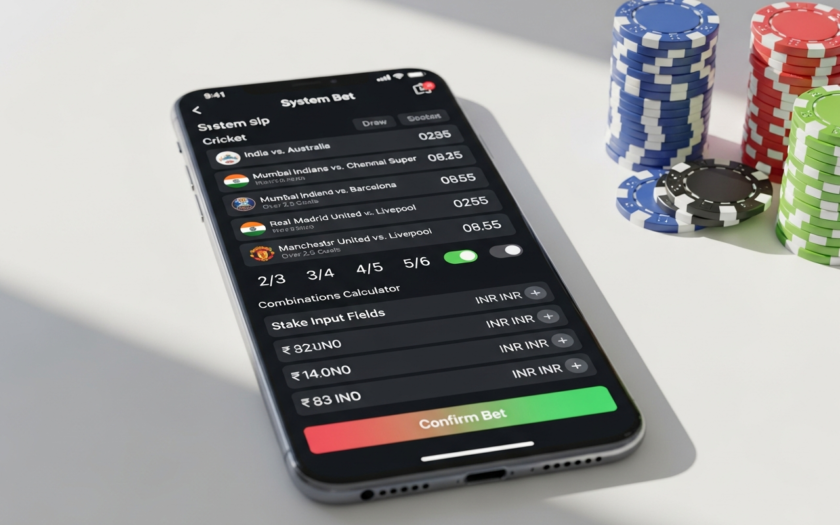
A system bet is a flexible wagering method that creates multiple overlapping combinations from the same set of selections, allowing bettors to win even if not all picks succeed. Unlike single bets or standard accumulators, system bets split your choices into smaller parlays, so a single losing selection doesn’t necessarily wipe out your entire stake.
This guide walks you through every step of placing a system bet on Indian betting platforms, from understanding key terminology like “System,” “Combinations,” and “2/3” notation to practical examples featuring IPL cricket, football, and kabaddi markets. Whether you’re using a desktop site or a mobile app that accepts INR deposits, you’ll learn how to navigate bet slips, control your bankroll, and make informed decisions about stake-per-line costs.
What Is a System Bet and Why Indian Bettors Use It
System bets require a minimum of three selections and automatically generate all possible combinations of a specified size. For example, if you pick three cricket matches and choose a “2 out of 3” system, the platform creates three separate doubles; you win as long as at least two of your three picks succeed. This structure provides partial-win insurance, making system bets attractive when confidence varies across selections.
Compared to singles or accumulators, system bets occupy a middle ground. A single bet risks one stake on one outcome, while an accumulator demands every leg to win for any payout. System bets spread risk across multiple smaller parlays but require a higher total stake because you’re effectively placing several bets at once. Indian bettors often use systems to hedge against unpredictable tournament formats in the IPL or knockout stages of football leagues, where one upset won’t destroy the entire wager.
The trade-off is clear: you pay more upfront but reduce the all-or-nothing pressure of accumulators. For bettors who want greater flexibility without dropping to single-bet odds, systems offer a structured way to manage uncertainty while still pursuing multi-leg multipliers.
System Bets vs Singles, Multiples and Accumulators
Understanding how system bets differ from other bet types helps clarify when each approach suits your strategy. The table below contrasts singles, accumulators, standard multiples, and system bets across key dimensions relevant to Indian bettors.
| Bet type | Minimum selections | Need all picks to win? | Risk level | Typical use case for Indian bettors |
|---|---|---|---|---|
| Single | 1 | Yes | Low | Confident match-winner bets in IPL or ODI series |
| Accumulator | 2+ | Yes | High | Chasing large payouts across multiple Premier League fixtures |
| Standard multiple (no coverage) | 2+ | Yes | High | Same as acca; common label on some Indian platforms |
| System bet | 3+ | No (partial wins possible) | Medium | Hedging across IPL playoffs, ISL, and kabaddi tournaments |
The key advantage of system bets is partial-win coverage. If you build a five-selection system requiring three winners, two losing picks won’t void your entire wager—some combinations will still settle as winning parlays.
Basic Terminology You’ll See on Indian Betting Sites
When you open the bet slip and switch from “Accumulator” to “System” or “Other Multiples,” you’ll encounter specific terms that define how your stake is distributed and how payouts are calculated. Familiarising yourself with these labels will prevent confusion during stake entry.
- System bet: The umbrella term for any wager that generates multiple combinations from your selections, allowing partial wins.
- Combinations: Individual parlays created by the system; for example, a 2/3 system generates three doubles.
- Banker: A selection that must appear in every combination; if it loses, all lines fail. Bankers increase risk but focus the system around a high-confidence pick.
- Stake per line: The amount wagered on each individual combination. Your total stake equals stake per line multiplied by the number of lines.
- 2/3 notation: The first number indicates how many picks must win per line; the second is your total number of selections. A 2/3 system means “two winners from three picks.”
- Other Multiples tab: The bet-slip section where many Indian platforms list system options alongside patents, trixies, and other named formats.
Core Mechanics: How System Bets Work Behind the Scenes
At its core, a system bet takes your selections and creates every possible combination of a specified size. Each combination is a separate bet line, and you stake the same amount on each line. Your total outlay is therefore the stake per line multiplied by the total number of lines generated.
For instance, if you choose four football matches and opt for a “3 out of 4” system, the platform calculates all possible trebles from those four picks—yielding four separate trebles. If you set ₹100 as your stake per line, your total stake becomes ₹400. Every treble that lands will pay out at the combined odds of its three legs, and your overall return is the sum of all winning lines.
The more selections you add or the larger the combination size, the more lines you create and the higher your total cost. This exponential growth in stake is why beginners are advised to start small and scale up only when confident in bankroll management. Understanding line generation is essential to controlling expenditure and avoiding unpleasant surprises at confirmation.
Minimum Selections and Popular System Formats
Different system formats require different numbers of picks and create varying numbers of bet lines. The table below details popular structures used by Indian bettors, especially for cricket and football markets.
| System name/notation | Required selections | Lines created | Min winners to get a return | Typical sports/markets in India |
|---|---|---|---|---|
| 2/3 | 3 | 3 doubles | 2 | IPL match-winner, EPL 1X2, kabaddi match bets |
| Trixie | 3 | 4 (3 doubles + 1 treble) | 2 | Cricket player runs, over/under markets across T20 |
| 3/4 | 4 | 4 trebles | 3 | Mixed football leagues (EPL, ISL, La Liga) |
| Yankee | 4 | 11 (6 doubles + 4 trebles + 1 four-fold) | 2 | IPL playoff stage, World Cup group matches |
| 3/5 | 5 | 10 trebles | 3 | Multi-sport (cricket, football, tennis) accumulators |
These formats balance coverage and cost. A 2/3 system is beginner-friendly with only three lines, while a Yankee’s eleven lines demand a higher total stake but offer more insurance against single losses.
Choosing an Indian Betting Platform That Offers System Bets
Not every betting site or app serving Indian customers displays a clear “System” option in the bet slip. When selecting a platform, prioritise the following features to ensure smooth system-bet placement and responsible bankroll control.
- Explicit system-bet support: Look for a dedicated “System” or “Other Multiples” tab within the bet slip, listing formats like Trixie, Yankee, and custom notations (2/3, 3/5).
- INR payment methods: Seamless deposits and withdrawals via UPI, Paytm, PhonePe, or net banking make stake management easier and avoid currency-conversion fees.
- Minimum and maximum stake limits: Platforms should allow small per-line stakes (₹10–₹50) to accommodate beginners testing system bets without excessive risk.
- Bet-slip preview: A real-time calculator showing total stake and potential returns before confirmation prevents costly mistakes.
- Responsible gambling tools: Deposit limits, self-exclusion options, and time-out features help maintain control, especially when total stakes scale quickly with large systems.
- Cricket and football market depth: Indian bettors need comprehensive coverage of IPL, ODI, T20 internationals, ISL, and major European leagues to build diverse system bets.
- Mobile app usability: A clean, responsive app interface ensures you can adjust system settings, review combinations, and confirm stakes on the go.
Where to Find System Bet Options in Indian Apps and Sites
Once you’ve added three or more selections to your bet slip, the platform typically displays bet-type tabs at the top or bottom of the slip. These tabs often read “Single,” “Multiple,” “Accumulator,” and “System” (or “Other Multiples”). Tapping or clicking the System tab reveals a dropdown or list of available formats based on your selection count.
For example, with three picks, you might see “2/3,” “Trixie,” or “Patent.” With four picks, “3/4,” “Yankee,” and “Lucky 15” appear. Some platforms use numeric notation exclusively (2/3, 3/5), while others mix named systems and numeric formats. If you cannot locate a System option, check the platform’s help section or contact support—some sites hide advanced multiples under submenus or require desktop mode for full access.
The key is to confirm that your chosen platform explicitly supports systems before depositing funds. A quick test with demo or minimum stakes will clarify whether the interface meets your needs and whether line generation matches your expectations.
Legal and Responsible Gambling Context for Indian Bettors
Most Indian bettors use offshore-licensed platforms because domestic sports-betting regulations remain limited and vary by state. While accessing these sites is common practice, it’s important to verify that your chosen operator holds a recognised international licence (Curacao, Malta, or UK Gambling Commission) and employs SSL encryption for transaction security.
Responsible gambling is especially critical with system bets, since total stakes can spiral when you add selections or increase per-line amounts. Set daily or weekly deposit limits within your account settings, and take advantage of self-exclusion or cooling-off periods if betting feels compulsive. Many platforms also offer reality checks—pop-up reminders of session length and spending—that help maintain awareness. Remember that no betting strategy, including system bets, guarantees profit; treat staking decisions as entertainment expenses and never wager money you cannot afford to lose.
Step‑by‑Step: Placing Your First System Bet on an Indian Site
Follow these steps to construct and confirm your first system bet. The process applies to both desktop sites and mobile apps that accept INR deposits and support system wagering.
- Log in and navigate to your preferred sport: Open the sportsbook lobby and select cricket, football, kabaddi, or any sport with upcoming events.
- Add your first selection: Click the odds for your chosen market (e.g., match winner, over/under) to add it to the bet slip. The slip will appear as a sidebar or pop-up.
- Add at least two more selections: System bets require a minimum of three picks. Choose additional markets—these can be from the same sport or different sports and tournaments.
- Switch to the System tab: In the bet slip, locate the “System” or “Other Multiples” tab. This reveals available system formats based on your selection count.
- Select your system type: Choose a format like “2/3” or “Trixie.” The platform will display the number of lines created and prompt you to enter your stake per line.
- Enter stake per line: Input the amount you want to wager on each individual combination (e.g., ₹50). The slip will calculate your total stake automatically.
- Review total stake and potential returns: Check the displayed total cost and estimated payout range. Ensure the figures align with your budget before proceeding.
- Confirm the bet: Tap or click “Place Bet.” Your system wager is now active, and all combinations will settle independently based on event outcomes.
- Track your bet: Navigate to “My Bets” or the bet-history section to monitor results as events conclude. Winning lines will credit your account individually.
Example: 3‑Selection System Bet on a Cricket and Football Combo
Imagine you want to combine confidence in two cricket markets with a football pick. You select Mumbai Indians to win their IPL match at odds of 1.80, India to win an ODI at 2.00, and Manchester United to beat a mid-table Premier League side at 1.70. Adding all three to the slip and choosing a “2 out of 3” system generates three doubles: Mumbai-India, Mumbai-United, and India-United.
Setting a stake of ₹100 per line means a total outlay of ₹300. If Mumbai and India both win but United loses, two of your three doubles (Mumbai-India at combined odds 3.60 and any other losing double) will settle. The winning Mumbai-India double returns ₹360, covering your initial ₹300 and netting a small profit. Had you placed a standard treble accumulator instead, United’s loss would have voided the entire bet. This example illustrates how system bets cushion against a single upset while still offering multiplier payouts.
You can adjust the scenario by increasing per-line stakes or adding a fourth selection to unlock trebles, but the principle remains: overlapping combinations provide partial-win insurance that accumulators cannot match.
Understanding System Bet Notation (2/3, 3/5, 3/8, etc.)
System notation uses two numbers separated by a slash. The first number specifies how many selections must win within each combination, and the second number represents your total selections. For example, “3/5” means you have five picks, and the platform creates all possible trebles (three-leg parlays) from those five. You need at least three winners among your five picks for any treble to pay out.
This format clarifies minimum-win requirements and helps bettors estimate coverage. A “2/4” system creates six doubles from four selections, requiring only two winners for returns. Meanwhile, a “4/6” system builds fifteen four-folds from six picks, demanding four correct results but offering higher multipliers per winning line. The larger the first number relative to the second, the fewer safety nets you have—but potential payouts per line increase because each combination includes more legs.
Indian betting platforms may also list named systems (Trixie, Yankee, Heinz) alongside numeric notation. These names correspond to specific selection and line counts but follow the same underlying logic: the system generates every possible combination of the stated size, and you win whenever enough picks land to complete any combination.
How Many Betting Lines Does a System Bet Create?
The number of lines—and thus your total stake—grows rapidly as you add selections or increase combination size. The table below shows how common system formats translate into bet lines, helping you anticipate costs before confirming the wager.
| System format | Number of selections | Lines created (combinations) | Impact on total stake |
|---|---|---|---|
| 2/3 | 3 | 3 | Low (3× per-line stake) |
| 3/4 | 4 | 4 | Low (4× per-line stake) |
| 2/4 | 4 | 6 | Moderate (6× per-line stake) |
| 3/5 | 5 | 10 | Moderate (10× per-line stake) |
| 4/6 | 6 | 15 | High (15× per-line stake) |
| 2/5 | 5 | 10 | Moderate (10× per-line stake) |
Always multiply the number of lines by your desired stake per line to calculate total cost. A ₹50-per-line stake on a 3/5 system (ten lines) means ₹500 total—a figure that can surprise beginners expecting three-figure outlays.
Coverage vs Cost: Choosing the Right System Size
Balancing comprehensive coverage against affordable stakes is the central challenge of system betting. The tips below help you select a system size that matches your budget and confidence level.
- Start with 2/3 or Trixie systems: These require only three picks and generate manageable line counts (three or four), making them ideal for first-time system bettors.
- Avoid large systems until confident: Formats like 4/7 or 5/8 create dozens of lines and demand substantial stakes; reserve these for experienced bettors with deep bankrolls.
- Match system size to selection confidence: If all picks feel equally strong, a larger first number (e.g., 4/5) maximises multiplier potential; if confidence varies, drop to 2/5 or 3/5 for more insurance.
- Use the bet-slip calculator: Before confirming, review the total stake figure displayed. If it exceeds your session budget, reduce per-line stake or remove a selection.
- Consider named systems for fixed structures: A Yankee (11 lines) or Patent (7 lines) offers predictable costs, helping you plan stakes without manual calculation.
Stake per Line, Total Stake and Potential Payouts
Every system bet charges a stake per line, which the platform multiplies by the number of combinations to determine your total outlay. Potential returns depend on which lines win and the combined odds of each winning combination. The table below demonstrates how stake settings and outcomes interact, using INR amounts familiar to Indian bettors.
| Example system | Stake per line | Number of lines | Total stake in INR | Outcome scenario | Approx. return |
|---|---|---|---|---|---|
| 2/3 | ₹100 | 3 | ₹300 | 2 wins (odds 1.8 & 2.0) | ₹360 |
| Trixie | ₹50 | 4 | ₹200 | All 3 win (avg odds 1.9) | ₹685 |
| 3/5 | ₹30 | 10 | ₹300 | 3 of 5 win (odds 2.1, 1.8, 2.0) | ₹227 |
| Yankee | ₹20 | 11 | ₹220 | 3 of 4 win (mixed odds) | ₹280 |
| 4/6 | ₹10 | 15 | ₹150 | 4 of 6 win (odds ~2.0 avg) | ₹160 |
These examples assume decimal odds and illustrate that returns vary widely based on how many selections win and their individual odds. Lower per-line stakes keep total risk manageable, while higher stakes amplify both potential profit and loss.
Using Calculators and Bet Slip Previews to Check Payouts
Most Indian betting platforms embed a stake calculator directly into the bet slip. After selecting your system type and entering a per-line stake, the slip displays total cost and an estimated payout range based on all selections winning or the minimum required winners landing. This preview is essential for avoiding sticker shock and ensuring the wager fits your budget.
If your platform lacks a built-in calculator, search online for “system bet calculator” tools. Enter your selection count, system format, per-line stake, and individual odds; the calculator will output total stake and potential returns for various win scenarios. Always cross-check these figures before confirming the bet, especially when experimenting with larger systems or unfamiliar formats. A few seconds of verification can prevent expensive miscalculations.
System Bets vs Accumulator Bets on Indian Platforms
System bets and accumulators both combine multiple selections for multiplied odds, but they handle losses differently. Understanding these differences helps you choose the right structure for your risk appetite and market confidence.
- Partial-win flexibility: Systems allow some selections to lose without voiding the entire wager, whereas accumulators require every leg to win.
- Higher upfront cost: Systems charge a stake per line, so total outlay exceeds a single accumulator stake for the same selections.
- Lower maximum payout: Because system wins are spread across smaller combinations, the top payout is usually less than a successful full accumulator at the same per-line stake.
- Risk mitigation: Systems suit bettors who want cushioning against one or two upsets; accumulators suit those confident all picks will land.
- Complexity: Accumulators are straightforward (one bet, one outcome), while systems require understanding line counts and partial-settlement mechanics.
- Bankroll impact: Systems can drain budgets faster if you’re not careful with per-line stakes, whereas accumulators risk less upfront but offer no partial recovery.
When to Prefer a System Bet over an Acca
Choose a system bet when your selections carry varied confidence levels or when you want insurance against a single leg failing. For example, if you’re confident in two IPL match-winners but less certain about a third kabaddi pick, a 2/3 system lets the strong picks salvage returns even if the kabaddi bet loses. Systems also shine during volatile tournaments—IPL playoffs or knockout football stages—where form swings and pitch conditions introduce unpredictability.
Accumulators remain preferable when all selections feel equally strong and you’re chasing maximum multiplier payouts. If you believe four football favourites will all win comfortably, a four-fold acca delivers higher returns than a 3/4 system for the same total stake. The trade-off is simple: systems sacrifice peak payout for downside protection, while accumulators gamble everything on perfection.
Common Mistakes With Systems on Indian Sites
Beginners often overbuild systems by adding too many selections, generating dozens of lines and inflating total stakes beyond their budget. Another frequent error is ignoring the total-cost display in the bet slip, leading to surprise when funds are deducted. Poor selection variety—picking three correlated cricket markets from the same match—also undermines the system’s hedging benefits, since one match outcome can sink multiple legs simultaneously.
Finally, many bettors confuse system bets with guaranteed-win schemes, expecting every scenario to yield profit. Systems reduce risk but cannot eliminate it; if fewer than the required number of picks win, you still lose money. Always treat system bets as a risk-management tool rather than a profit guarantee, and diversify selections across different sports, tournaments, or match days to maximise independence.
Using Bankers in System Bets
A banker is a selection you designate as essential, forcing it to appear in every combination the system generates. This increases risk because if the banker loses, all lines fail. However, bankers also reduce the number of lines—and thus the total stake—by anchoring combinations around one high-confidence pick.
For example, a standard 2/4 system with no banker creates six doubles from four selections. Adding one banker transforms the bet into a 1 banker plus 2/3 system on the remaining three picks, generating only three doubles (banker paired with each possible double from the other three). If the banker wins, you need just one more winner from the remaining picks to land a double. If the banker loses, the entire wager is void.
Indian bettors often use bankers for dominant teams in IPL or clear favourites in international ODI series. The reduced line count makes large systems affordable, but the single-point-of-failure risk demands extreme confidence in the banker selection.
Practical Example of a System Bet with a Banker
Consider a four-selection system covering an IPL playoff match, an ODI, a Premier League game, and an ISL fixture. You’re highly confident Mumbai Indians will win the IPL match, so you mark it as the banker. The remaining three picks form all possible doubles, and each double must include Mumbai Indians.
| Selection | Market | Role (banker/regular) | Included in how many lines? | Impact if it loses |
|---|---|---|---|---|
| Mumbai Indians win | IPL playoff | Banker | All 3 | Entire system voids |
| India win ODI | International cricket | Regular | 1 (Mumbai-India) | Only Mumbai-India double fails |
| Arsenal win | Premier League | Regular | 1 (Mumbai-Arsenal) | Only Mumbai-Arsenal double fails |
| Bengaluru FC win | ISL | Regular | 1 (Mumbai-Bengaluru) | Only Mumbai-Bengaluru double fails |
If Mumbai Indians win and at least one other pick succeeds, you collect on that double. If Mumbai loses, all three doubles void regardless of other results. This setup costs three lines instead of six, but it ties your entire wager to one team’s performance.
Adapting System Bets to Popular Indian Sports and Markets
Different sports and markets lend themselves to different system structures. The table below suggests typical system styles for the sports and betting markets most popular among Indian bettors, along with risk profiles and practical notes.
| Sport/market | Typical system style | Example selections | Risk profile | Notes for Indian bettors |
|---|---|---|---|---|
| IPL match-winner | 2/3 or Trixie | Mumbai, Chennai, Rajasthan to win | Medium | Form swings common; 2/3 offers cushion |
| Cricket player runs | 3/5 | Kohli over 30.5, Rohit over 25.5, etc. | High | Player form volatile; diversify across matches |
| Football 1X2 | Yankee or 3/4 | EPL, La Liga, ISL home wins | Medium | Mix leagues for independence; avoid derbies |
| Kabaddi match-winner | 2/3 | PKL playoff teams | Medium | Lower liquidity; smaller stakes advised |
| Tennis match-winner | Trixie | Grand Slam favourites | Low–medium | Top seeds reliable; avoid qualifier rounds |
| Over/under totals | 3/5 | Cricket run totals, football goals | High | Weather and pitch impact cricket; track conditions |
Tailoring system size and selection mix to each sport’s volatility helps balance potential returns against realistic win probabilities.
Combining Pre‑Match and In‑Play Selections in a System
Many Indian platforms allow you to mix pre-match and live (in-play) picks within the same system bet. This flexibility lets you lock in early value on certain markets while reacting to live-match developments for others. For example, you might add two pre-match IPL winners to your slip, then watch the first few overs of a third match and add a live over/under or next-wicket market once you assess conditions.
However, be aware that live odds shift rapidly, and some in-play markets expire or suspend if events unfold quickly. If a live selection is voided, the platform typically treats it as a non-runner, reducing your system to fewer picks. Always confirm your bet before events conclude, and avoid mixing too many live legs unless you can monitor all matches simultaneously. Combining stable pre-match favourites with one or two opportunistic live picks is a balanced approach that leverages both advance research and real-time insight.
Handling Different Odds Formats (Decimal, Fractional, American)
Most Indian betting sites default to decimal odds, which simplify system-bet calculations because you multiply stake by the decimal to get gross return. For a double at 2.00 and 1.80, the combined odds are 3.60; a ₹100 stake returns ₹360. Some platforms offer fractional (e.g., 4/5) or American (+150) formats in settings, but decimal remains the standard for INR-denominated markets.
If you prefer fractional or American odds for familiarity, switch formats in your account settings or the bet-slip menu. Just remember that payout previews will reflect the chosen format, so cross-check that you understand the displayed figures before confirming large system bets.
Risk Management and Bankroll Strategy for System Bets
System bets can drain bankrolls faster than singles or even accumulators if you ignore total-stake arithmetic. The following tips help you maintain discipline and avoid overextending your budget on complex multi-line wagers.
- Set a per-session system budget: Allocate a fixed percentage of your bankroll (e.g., 5–10%) to system bets and do not exceed that limit regardless of win or loss streaks.
- Keep per-line stakes small: Start with ₹20–₹50 per line, especially for systems generating more than five lines. This caps total exposure while preserving enough combinations to see returns.
- Calculate total stake before confirming: Always review the displayed total cost. If it feels uncomfortable, reduce the per-line amount or drop a selection to shrink line count.
- Use deposit limits and reality checks: Enable platform tools that alert you to spending thresholds or session duration, preventing impulsive expansion of system sizes mid-session.
- Track long-term results: Maintain a simple spreadsheet logging system type, total stake, and net return. Over time, identify which formats and sports yield consistent profits or losses.
- Avoid chasing losses with bigger systems: If a system bet loses, resist the urge to immediately place a larger system to recoup. Stick to your pre-set stakes and re-evaluate selections calmly.
- Diversify selections across events: Spread picks over different matches, days, or sports to reduce correlation risk and avoid total wipeouts from a single poor-performing tournament day.
Examples of Sensible and Risky System‑Bet Bankroll Setups
A sensible approach for a beginner with a ₹5,000 monthly betting budget might allocate ₹500 to system bets, placing no more than ₹50 per line on 2/3 or Trixie structures. This creates a maximum exposure of ₹150–₹200 per system, allowing multiple wagers across the month without exhausting funds early. Wins can be reinvested cautiously, and losses remain contained within the allocated envelope.
A risky setup would involve taking that same ₹5,000 bankroll and placing a single Goliath system (247 lines) at ₹20 per line—consuming ₹4,940 in one bet. While a Goliath offers extensive coverage, it ties nearly the entire budget to eight selections. One or two key losses can still leave you short of break-even, and you have no capital left for other bets that month. Such aggressive strategies suit only experienced bettors with deep pockets and proven track records, not newcomers experimenting with system mechanics.
Advanced System Bet Structures and When to Avoid Them
Named systems like Heinz (57 lines from six selections), Super Heinz (120 lines from seven), and Goliath (247 lines from eight) bundle doubles, trebles, four-folds, and higher into a single wager. These formats appeal to high-stakes bettors seeking maximum coverage, but the sheer line count and total cost make them unsuitable for casual players or limited budgets.
For example, a Heinz at ₹10 per line costs ₹570 total. Unless you’re confident in at least four or five winners from six picks, the returns may not justify the outlay. Beginners should avoid these structures until they’ve mastered smaller systems and developed reliable selection methods. Even experienced bettors reserve large systems for special events—major tournaments or high-conviction weekends—where research justifies the investment.
When Bigger Systems Add Value and When They Don’t
Larger systems make sense when you have six or more selections at genuinely attractive odds (2.00+) and believe at least four will win. The extensive line coverage means partial wins can still yield respectable returns, and the multiplier effect across multiple trebles and four-folds amplifies profit if most picks succeed.
- High-value scenario: Tournament accumulator across IPL playoffs, Champions League knockouts, and tennis Grand Slam favourites, with research-backed confidence in five of seven picks.
- Low-value scenario: Throwing eight random match-winners into a Goliath hoping for luck, without statistical or form analysis backing each selection.
- Cost efficiency: If the required number of winners to break even approaches your total selections (e.g., needing six of eight), a simpler accumulator or smaller system often delivers better ROI.
- Liquidity and limits: Large systems can hit platform maximum-payout caps, capping your upside even if all legs win. Check terms before committing.
In general, bigger systems are tools for seasoned bettors with ample bankrolls and robust research processes, not shortcuts to easy wins.
Separating Betting Systems from ‘Guaranteed Win’ Schemes
Online forums and social media sometimes promote “systems” claiming guaranteed profits or risk-free returns. These schemes often conflate legitimate system bets with dubious betting strategies (Martingale, Fibonacci progressions) or outright scams. True system bets—combinations of selections—offer no guarantee; they simply redistribute risk across multiple smaller parlays.
Be sceptical of any service or tipster promising that a specific system format will always win. Betting outcomes depend on event results, not mathematical structures. While systems can improve your risk-reward balance compared to all-or-nothing accumulators, they remain speculative wagers subject to variance and the inherent unpredictability of sports. Responsible system betting means accepting losses, managing stakes, and never chasing mythical “sure things.”
Checklist Before You Confirm a System Bet on an Indian Platform
Running through a pre-confirmation checklist prevents common errors and ensures your system bet aligns with your strategy and budget. Follow these steps every time before clicking “Place Bet.”
- Verify selection count and system format: Confirm the bet slip displays the correct number of picks and the intended system notation (e.g., 2/3, Trixie).
- Check individual odds: Ensure no odds have shifted dramatically since you added selections; live markets can change rapidly.
- Review total stake: Multiply stake per line by the number of lines and confirm the total matches your session budget.
- Confirm minimum winners: Understand how many picks must succeed for any payout. If the requirement feels too high, consider a lower-number system.
- Inspect banker status: If you’ve designated a banker, double-check it’s marked correctly and that you’re comfortable with the single-point-of-failure risk.
- Assess correlation: Ensure selections are sufficiently independent; avoid multiple legs from the same match or highly correlated events.
- Review potential returns: Use the bet-slip preview or a calculator to gauge best-case and worst-case payouts, ensuring they justify the risk.
- Confirm within limits: Check that your total stake doesn’t breach daily deposit limits or personal budget caps you’ve set for responsible gambling.
After Placing: Tracking and Settling Your System Bets
Once you confirm the system bet, navigate to the “My Bets,” “Open Bets,” or bet-history section of your platform. System bets often appear as a single entry with an expandable view showing all individual lines. As events conclude, the platform settles each line independently, crediting returns for winning combinations and voiding losing ones.
Final settlement can take a few minutes to several hours, depending on the sport and whether official results need verification. If you notice discrepancies—incorrect odds applied or missing payouts—contact customer support immediately with your bet reference number. Keep screenshots of your bet confirmation and the bet-slip preview as proof. Most reputable platforms resolve settlement disputes quickly, especially when you provide clear documentation. Regularly reviewing your bet history also helps you learn which system formats and sports yield the best results, informing future wagering decisions.